The Toyota HiAce is a van and minibus range that Toyota has built since 1967, and the 2019 model marks the start of the sixth generation, coded H300. This generation made its global debut on 18 February 2019 in the Philippines and is the first HiAce to use a semi-bonnet layout, placing a short hood and engine ahead of the cabin instead of the flat-nosed cab-over design of its predecessors. Development was led by chief engineer Takuo Ishikawa, and Toyota built the H300 on a platform developed specifically for the model.

Generations and History
The HiAce name dates to 1967, when the first H10 model was introduced as a pickup before the line grew to include vans and buses. Successive generations arrived in 1977, 1982, 1989 and 2004, and by 2019 the H200 range was still being used around the world, with more than 50 years of continuous production behind the nameplate. Toyota positions the HiAce as a working vehicle for logistics, tourism and passenger transport, and the H300 was developed as a new series aimed primarily at overseas markets; the previous H200 model continued on sale in Japan because of differences in the local market.
Exterior and Design

The H300 introduced a semi-bonnet design developed to improve crash protection and passenger comfort compared with the old flat-front HiAce. It uses front-engine, rear-wheel drive. The range spans a standard-roof van, a long/high-roof van and a commuter minibus. Wheelbase choices run from 2,570 mm (101.2 in) on the four-cylinder standard-roof long-wheelbase van up to 3,860 mm (152.0 in) on the long/high-roof super-long-wheelbase version, with overall length from 5,265 mm (207.3 in) to 5,915 mm (232.9 in), width of 1,880 to 1,970 mm (74.0 to 77.6 in) and height of 1,990 to 2,285 mm (78.3 to 90.0 in). Curb weight ranges from about 1,715 kg to 2,290 kg (3,781 to 5,049 lb).
Interior and Configurations

The HiAce is a commercial workhorse available as a panel van, a people-carrying van and a minibus, with seating configurations covering van, crew and commuter layouts. The semi-bonnet body gave the cabin more usable space and easier entry than the cab-over design. In Australia the range launched with five grades: LWB Van, LWB Crew Van, SLWB Van, SLWB Commuter and SLWB Commuter GL, with the 3.5-liter V6 offered only on the long-wheelbase and super-long-wheelbase grades and the six-speed manual restricted to the LWB Van. In the Philippines Toyota offered a 15-seater Commuter Deluxe, 12-seater GL Grandia, 14-seater GL Grandia Tourer and 10-seater Super Grandia.
Engines and Drivetrain
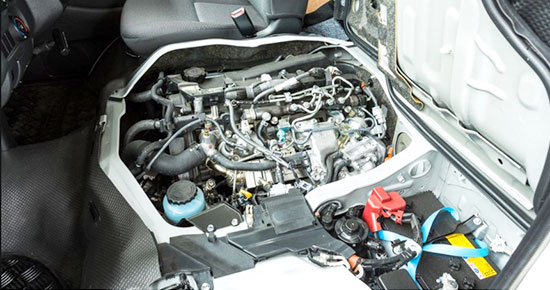
Toyota offered two families of engine in the H300 HiAce. The 2.8-liter 1GD-FTV turbocharged diesel inline-four was rated between 115 kW and 130 kW (roughly 154 to 174 hp), with torque between 420 Nm and 450 Nm depending on market and transmission. The naturally aspirated 3.5-liter 7GR-FKS V6 gasoline made 207 kW (277 hp) at 6,000 rpm and 351 Nm at 4,600 rpm. A 2.7-liter 2TR-FE four-cylinder gasoline was also offered in some markets, producing 120 kW (161 hp) and 244 Nm at 4,000 rpm. The desel was the only engine offered in many markets. Transmissions were a five- or six-speed manual or a six-speed AC60 automatic, and all versions drove the rear wheels.
Safety
The H300 HiAce was awarded a five-star rating by ANCAP in 2019 for its van and crew van variants, and the related Toyota Majesty received five stars from ASEAN NCAP the same year. Toyota fitted the new model with a stronger body structure and advanced driver-assistance features as standard or optional depending on the market and grade, including autonomous emergency braking in some versions.
Availability and Pricing
After its Philippine debut the H300 rolled out across world markets through 2019, reaching Australia on 28 May 2019 and Thailand in June, among others. Australian pricing started at A$38,640 before on-road costs for the manual V6 LWB model and rose to about A$70,140 for the automatic diesel Commuter GL, and Toyota quoted diesel fuel consumption of 7.5 L/100km manual and 8.2 L/100km automatic for the LWB van, and 8.4 L/100km for the SLWB and LWB crew van. A more luxurious passenger version was sold as the Granvia in Australia and Taiwan, the GranAce in Japan and the Majesty in Thailand. Compare it with the 2019 Toyota C-HR Review in our Car Review section.
Global Markets
Following the Philippine launch, the H300 HiAce spread through Toyota’s overseas network during 2019. Australia took the model on 28 May, Thailand in June, and Mexico in August, while Indonesia received it as the HiAce Premio from July. In the Philippines the range ran from a 15-seater Commuter Deluxe to a 10-seater Super Grandia, all powered by the 2.8-liter turbodiesel. Production was based in Japan at Toyota Auto Body’s Inabe plant and Gifu Auto Body’s Kakamigahara plant, with additional assembly in Thailand and, later, Argentina.
Successors and Legacy
The H300 replaced the long-running H200 in most export markets and continued the HiAce tradition as one of Toyota’s longest-lived nameplates. The semi-bonnet layout that debuted with the H300 was retained in later updates of the model. A more luxurious derivative, badged Granvia, Majesty, GranAce or HiAce Super Grandia depending on the market, extended the range into premium shuttle and tourism roles, and the H300 remained in production well beyond 2019.