The 2019 Toyota Prius Prime is the plug-in hybrid member of the fourth-generation Prius family. Based on the XW50 Prius that launched for 2016, the Prime went on sale in the US in November 2016 for the 2017 model year and was produced through 2022. For 2019 it combined a 1.8-liter gasoline engine with a larger battery and a more powerful electric motor, offering about 25 miles of electric-only range before switching to hybrid operation.
The Prime is a plug-in hybrid (PHEV), meaning it can be charged from an external power source and driven on electricity alone for short distances. That separates it from the standard, non-plug-in Prius and from smaller hybrids such as the 2019 Toyota Prius C Hybrid Review, which rely on a small battery charged by the engine and by regenerative braking.
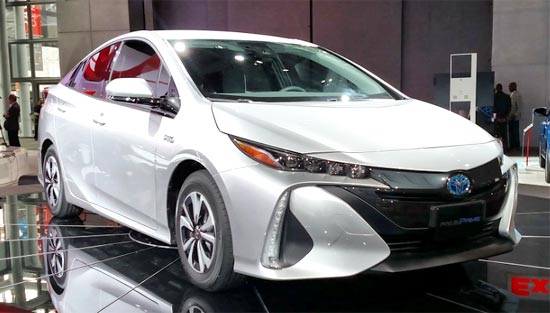
Overview
Toyota introduced the Prius Prime name for the second-generation Prius Plug-in Hybrid, which arrived for the 2017 model year in North America. It was built on the same Toyota New Global Architecture (TNGA) platform as the fourth-generation Prius but used a distinct front and rear design, a larger battery, and a more powerful electric motor. Toyota sold it in three trims for 2019: Plus, Premium, and Advanced.
The Prime’s defining feature was its 8.8 kWh lithium-ion battery, which was roughly twice the capacity of the first-generation Prius Plug-in Hybrid. That larger battery is what allowed the car to complete short trips on electricity alone, reducing gasoline use for drivers who could plug in regularly.
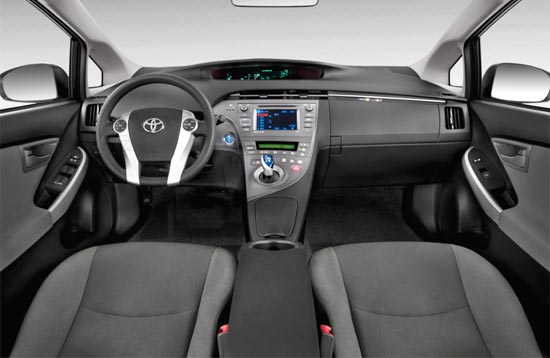
Interior and Features
The 2019 Prius Prime came with a 7-inch touchscreen with navigation, a rearview camera, Bluetooth, USB, satellite radio, and Toyota’s Entune App Suite. Upper trims added a large 11.6-inch portrait-oriented touchscreen, a head-up display, and premium audio. All versions included Toyota Safety Sense features such as adaptive cruise control, lane departure alert, and automatic high beams.
Because the battery sits under the rear load area, the Prime’s cargo space was close to that of the standard Prius but with a slightly raised floor. The 2019 model seated five and offered about 20 cubic feet of cargo volume. The interior was classified by the EPA as a midsize car with 91 cubic feet of passenger space, making the Prime roomier than its subcompact relatives.

Engine and Powertrain
The 2019 Prius Prime paired a 1.8-liter four-cylinder engine, rated at about 95 horsepower, with an electric motor producing 71 horsepower and 120 pound-feet of torque, fed by the 8.8 kWh battery. Combined system output was 121 horsepower and 105 pound-feet of torque, delivered to the front wheels through a continuously variable transmission.
Toyota quoted a 0–60 mph time of around 10.5 seconds, so the Prime prioritized efficiency over acceleration. In electric-only mode the car could reach highway speeds for limited distances before the gasoline engine engaged. The rear motor setup that appears in the AWD-e version of the conventional Prius is not part of the Prime’s drivetrain.

Electric Range and Charging
The EPA rated the 2019 Prius Prime at 25 miles of electric-only range, 133 MPGe combined on electricity, and 54 mpg combined when running on gasoline alone, for a total driving range of about 640 miles. Those figures made the Prime one of the most efficient plug-in hybrids on sale in 2019.
Recharging the 8.8 kWh battery takes about 5.5 hours from a standard 120-volt outlet or roughly 2 hours using a 240-volt (Level 2) charger with the onboard 3.3 kW charger. As with any plug-in, real-world electric range depends on temperature, terrain, and driving style.
Price and Trim Levels
KBB lists the 2019 Prius Prime with a starting MSRP of about $27,350 and a top price near $33,350 depending on trim. The three trims—Plus, Premium, and Advanced—shared the same powertrain, with equipment separating them. Buyers who qualified for the federal plug-in tax credit at the time could reduce the effective cost; credit eligibility has since changed and is not a current figure.
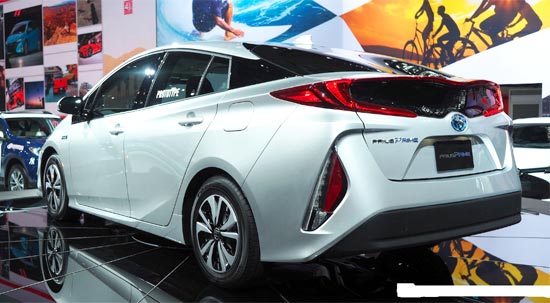
Dimensions
The 2019 Prius Prime measured 182.9 inches long, 69.3 inches wide, and 57.9 inches tall, with a curb weight of roughly 3,365–3,375 pounds. Its length placed it in the midsize class by EPA standards, well above the subcompact Prius c. The Toyota Review section has broader model coverage.
The Prime’s three trims differed mainly in equipment rather than capability. The base Plus included the 7-inch touchscreen, adaptive cruise control, a rearview camera, and Toyota Safety Sense. The Premium added simulated-leather upholstery and additional convenience features, while the Advanced topped the range with the 11.6-inch portrait touchscreen, a head-up display, and the JBL premium audio system.
Toyota designed the Prius Prime for drivers who wanted the efficiency of a Prius but with the ability to run on electricity for short daily trips. A full charge provided about 25 miles of electric range, enough to cover many commutes without using gasoline. Once the battery was depleted, the car operated as a conventional hybrid and returned 54 mpg combined, giving a total range of roughly 640 miles on a full tank and a full charge.
The Prime could not match the acceleration of a purely gasoline compact, and its electric-only operation was intended for lower-speed driving. In practice the car blended the two power sources automatically, calling on the engine when more power was needed. That behavior made it straightforward to drive without any special technique beyond plugging it in regularly to realize the electric range.