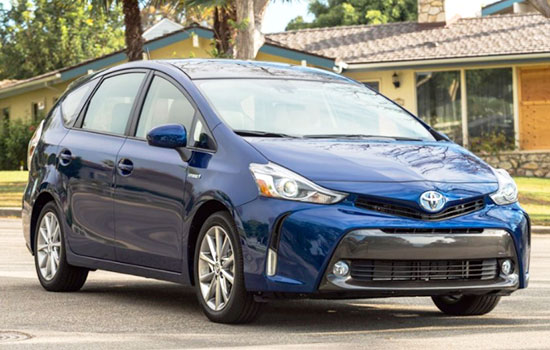
There was no 2019 Toyota Prius v on sale in the United States. Toyota ended US sales of the Prius v after the 2017 model year, and the global version of the car — the Prius α in Japan and Prius+ in Europe — was built from May 2011 until March 2021. The Prius v was the wagon of the Prius family: a taller, boxier five-door with more cargo space than the standard Prius liftback.
What the Prius v was
The Prius v joined the Prius line in 2011 as a compact wagon aimed at families who wanted hybrid economy but more room than the regular Prius. In the United States it went on sale in October 2011 for the 2012 model year as a two-row, five-seat car with a nickel-metal hydride battery. Japanese and European versions offered a three-row, seven-seat layout using a lithium-ion battery mounted in the center console. By April 2016 global sales of the Prius α/v/+ had reached about 634,000 units, with the majority sold in Japan.

Engine and hybrid system
Every Prius v used a 1.8-liter four-cylinder gasoline engine, code 2ZR-FXE, running on the Atkinson cycle with Dual VVT-i, paired with a 60 kW electric motor through Toyota’s Hybrid Synergy Drive. Combined system output was 134 hp, sent to the front wheels through an eCVT, a gearless planetary transmission. There was no plug-in version of the Prius v; the car charged itself from the engine and regenerative braking.
The US Environmental Protection Agency rated the Prius v at 44 mpg city, 40 mpg highway and 42 mpg combined. That figure is lower than the contemporary Prius liftback because the wagon is heavier and less aerodynamic. Under the European NEDC test the Prius+ was quoted at about 4.1–4.4 L/100 km with CO2 emissions of 96–101 g/km, which made some versions exempt from UK road tax at launch.
| Toyota Prius v | Specification |
|---|---|
| Also sold as | Prius α (Japan), Prius+ (Europe) |
| Production | May 2011 – March 2021 (global); US 2012–2017 |
| Engine | 1.8 L 2ZR-FXE Atkinson-cycle four-cylinder |
| Electric motor | 60 kW |
| Combined output | 134 hp |
| Transmission | eCVT, front-wheel drive |
| EPA economy | 44 city / 40 highway / 42 combined mpg |
| Seating | Five (US); Five or seven (Japan, Europe) |

Why US sales ended after 2017
US Prius v sales faded after the Toyota RAV4 Hybrid arrived in 2015. The RAV4 Hybrid offered similar fuel economy with all-wheel drive and more space, and buyers moved to it. Toyota confirmed that the 2017 model year would be the wagon’s last in the United States, with no 2018 version. The RAV4 Hybrid effectively took the Prius v’s place in Toyota’s US line-up.
The Prius α continued in Japan and the Prius+ in Europe for several more years. On 1 December 2020 Toyota announced that the Prius α would be discontinued from March 2021.
In Australia and New Zealand the Prius v was withdrawn and replaced indirectly by the larger Kluger Hybrid (the Highlander) in July 2021; that model is covered on this site as the 2019 Toyota Highlander Redesign and Release Date. Toyota’s other family-focused people mover in South Africa, the 2019 Toyota Quantum Release Date and Redesign, is unrelated to the Prius v but served a similar role for larger groups.

What buyers can buy instead
With no 2019 Prius v, anyone wanting that shape of hybrid hybrid wagon must look used or choose a different model. Toyota’s modern replacements are the RAV4 Hybrid and the Corolla Touring Sports Hybrid in Europe, while the seven-seat hybrid role moved to larger SUVs. The Prius family in 2017, the wagon’s last US year, consisted of the Prius liftback, the Prius Prime plug-in hybrid, the small Prius c and the Prius v.

US sales and the rise of the RAV4 Hybrid
The Prius v started strongly in the United States, with 8,399 sales in 2011 and 40,669 in 2012, but then fell to 34,989 in 2013, 30,762 in 2014 and 28,290 in 2015. The arrival of the RAV4 Hybrid in 2015 accelerated that decline, and US sales ended after the 2017 model year. The lesson Toyota drew was that US buyers preferred a hybrid crossover to a hybrid wagon.
Interior, features and pedestrian warning
US models of the 2012 Prius v included Toyota’s Vehicle Proximity Notification System, which plays a synthetic sound below about 15 mph so that pedestrians and cyclists can hear the near-silent car approaching. The warning was required by the US Pedestrian Safety Enhancement Act of 2010, and its pitch rises and falls with vehicle speed. Toyota said the Prius v produced 66% less smog-forming emissions than the average new vehicle of the time.
Prius v at a glance
- No 2019 model: US sales ended after 2017
- Global production: May 2011 – March 2021
- Engine: 1.8 L 2ZR-FXE four-cylinder plus 60 kW electric motor
- Combined output: 134 hp through an eCVT
- EPA economy: 42 mpg combined
- US replacement: RAV4 Hybrid
The Prius family in 2017
By the Prius v’s final US year the Prius family had expanded and then begun to contract. It comprised the main Prius liftback, the Prius Prime plug-in hybrid, the subcompact Prius c and the Prius v wagon. The Prius c and Prius v were both eventually dropped, leaving the liftback and the plug-in as the surviving members of the line. The downsizing of that family is why the wagon was not replaced with another hybrid wagon.