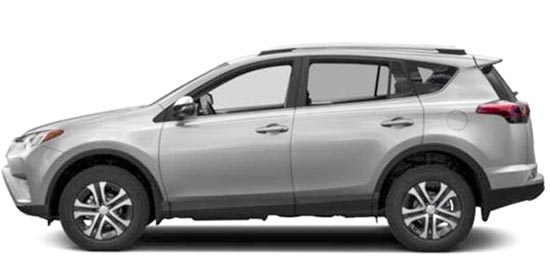
The 2019 model year brought the biggest change in the RAV4 Hybrid’s history: an all-new fifth-generation car. Toyota replaced the previous RAV4 Hybrid with a model built on the GA-K platform, gave it a more powerful hybrid system, standard all-wheel drive and a new sporty XSE grade, and moved production of the nameplate into its next generation. The changes were comprehensive rather than cosmetic, and they reshaped how the RAV4 Hybrid compared with both its own gas sibling and the wider compact-crossover class.

What Changed for 2019
The 2019 RAV4 Hybrid was not a facelift of the old car but a ground-up redesign. The most important changes were:
- A new platform — the GA-K version of Toyota’s New Global Architecture (TNGA), which also underpinned the Camry.
- A more powerful hybrid system rated at 219 hp combined, versus roughly 194 hp in the previous RAV4 Hybrid.
- Standard all-wheel drive with a separate rear electric motor, replacing the earlier model’s electrically driven rear axle setup.
- A new hybrid-only XSE grade, giving the lineup a sportier option for the first time.
- A larger, boxier body with more ground clearance (8.4 inches on lower trims) and a taller driving position.
- Standard Toyota Safety Sense 2.0, with automatic emergency braking and adaptive cruise control on every trim.
- An updated Entune 3.0 infotainment system with a 7-inch or 8-inch touchscreen and Apple CarPlay.

Engine and Hybrid System Specifications
The 2019 RAV4 Hybrid used a 2.5-liter four-cylinder Atkinson-cycle engine paired with three electric motors through an electronically controlled continuously variable transmission. The gasoline engine alone produced 176 hp and 163 lb-ft of torque; combined system output was 219 horsepower. Because the electric motors supplied their torque instantly and a rear motor drove the back wheels, the hybrid was the quickest RAV4 of its year.
| Specification | 2019 RAV4 Hybrid |
|---|---|
| Engine | 2.5 L four-cylinder + 3 electric motors |
| Combined output | 219 hp |
| Engine output | 176 hp / 163 lb-ft |
| Transmission | e-CVT (electronically controlled CVT) |
| Drivetrain | All-wheel drive (standard) |
| 0-60 mph (Car and Driver) | 7.4 seconds |
| EPA combined | 40 mpg |
| Fuel type | Regular unleaded |
Performance
The hybrid weighted about 156 pounds more than the equivalent gas RAV4, yet it accelerated faster thanks to its electric torque. Car and Driver recorded a 0-60 mph sprint of 7.4 seconds, 0.7 second quicker than the 203-hp gasoline Adventure model it also tested at 8.0 seconds. Toyota itself quoted a 0-60 figure of 7.8 seconds for the hybrid, a little more conservative than the independent result.
Dimensions and Cargo
The hybrid matched the gas model’s exterior footprint and interior packaging, so it gave up essentially nothing in space to gain its efficiency.
| Specification | Value |
|---|---|
| Length | 180.9 in |
| Width | 73.0 in |
| Height | about 67 in |
| Wheelbase | 105.9 in |
| Ground clearance | 8.4 in (lower trims) |
| Cargo volume (rear seats up) | 37.6 cu ft |
| Maximum cargo volume | 69.8 cu ft |
| Curb weight | approx. 3,500 lb |
Trim Levels and Equipment
The 2019 RAV4 Hybrid came in four grades, all with all-wheel drive. The LE was the value trim; the XLE added a moonroof, blind-spot monitoring and dual-zone climate control; the XSE added heated power front seats, leatherette-and-cloth upholstery, a power liftgate and 18-inch black alloy wheels; and the Limited added navigation, heated front seats, a rearview-camera mirror and ambient lighting. Prices ran from $27,850 to $35,850.
Fuel Economy
The EPA rated the 2019 RAV4 Hybrid at 41 mpg city, 38 highway and 40 combined — about ten mpg better than the gas front-drive RAV4’s 30 mpg combined. Car and Driver saw 37 mpg on its 75-mph highway test and a 32 mpg mixed average. The hybrid’s smaller 18-inch tires offered slightly less grip and longer stopping distances than the gas car’s, a trade-off reviewers accepted in exchange for the efficiency.

The scale of the change is easier to appreciate in context: the previous RAV4 Hybrid sat on the older MC platform and made do with a less powerful system. For 2019, Toyota moved the hybrid onto the same modern architecture as the Camry and the redesigned RAV4 gas model, which improved ride comfort, body rigidity and crash performance as well as packaging. Production of the fifth-generation RAV4 began in late 2018, and the hybrid grades joined the range in late March 2019, roughly three months after the gas cars.
On the road, reviewers found the hybrid smoother and quieter than the gas model in normal driving, with the electric motors filling in low-speed responses that the gasoline engine alone handled less gracefully. Car and Driver noted that the hybrid’s smaller 18-inch tires offered a little less grip than the gas car’s larger rubber and required longer braking distances, but judged the overall package a clear win for efficiency-minded buyers.
Safety and Technology
Toyota Safety Sense 2.0 was standard on every 2019 RAV4 Hybrid and included forward collision warning with automatic emergency braking, daytime pedestrian and cyclist detection, lane-departure warning with steering assist, lane-keep assist, full-speed adaptive cruise control, automatic high beams and road-sign assist. The infotainment system offered Apple CarPlay but not Android Auto. For related coverage see the 2019 Toyota RAV4 SE Hybrid Review and the 2019 Toyota Camry Atara SX Release Date, Canada.
Summary
For 2019 the RAV4 Hybrid changed from a niche efficiency model into a mainstream one. It gained power, standard all-wheel drive, an all-new platform, a broader safety package and a dedicated sporty trim, while keeping a fuel-economy advantage of about ten mpg over the gas RAV4. Car and Driver’s verdict that it was “the RAV4 to have” reflected how completely the redesign closed the gap between the hybrid and the rest of the range.