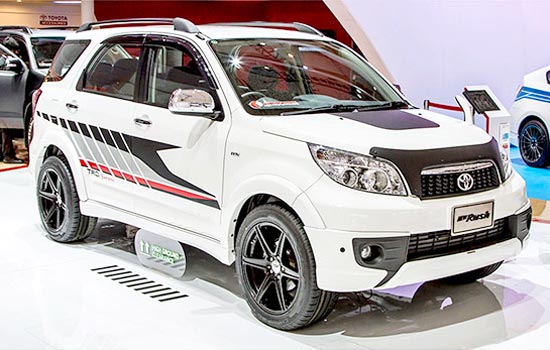
The Toyota Rush is a seven-seat mini SUV that Toyota sells in Indonesia, the Philippines and other Southeast Asian markets. The 2019 Rush belonged to the third generation, which went into production in November 2017 and is closely related to the Daihatsu Terios. This article covers the verified engine specifications, dimensions and Philippine pricing of the 2019 model.
What the Toyota Rush Is
The Rush is the Toyota-badged version of the Daihatsu Terios, a compact seven-seat SUV built on a unibody chassis with rear-wheel drive. The third generation, model code F800, entered production in Indonesia in November 2017. In Malaysia the same vehicle is sold as the Perodua Aruz. Unlike the earlier short-wheelbase Terios, the third-generation Rush is a long-wheelbase model with three rows of seats, positioning it as an affordable family SUV rather than an off-roader.
For comparison with other small Toyotas, see the 2019 Toyota Urban Cruiser Release Date and Price and the 2019 Toyota Avanza Philippines Review.
Engine and Drivetrain

The 2019 Rush was powered by a 1.5-liter 2NR-VE four-cylinder gasoline engine producing about 103 hp (76.5 kW) and 134 Nm of torque. Power went to the rear wheels through either a five-speed manual or a four-speed automatic transmission. Toyota’s Philippine specification listed 102 hp and 134 Nm. The engine used Dual VVT-i variable valve timing. The Rush offered only rear-wheel drive; there was no all-wheel-drive option in this generation.
Exterior and Dimensions

The third-generation Rush measured 4,435 to 4,466 mm long, 1,695 mm wide and 1,705 mm tall, on a 2,685 mm wheelbase. Curb weight was between 1,245 and 1,270 kg. The SUV rode on 16-inch alloy wheels with 215/65R16 tires and paired MacPherson strut front suspension with a live axle and coil springs at the rear. Brakes were discs at the front and drums at the rear. The fuel tank held 45 liters.
Interior and Equipment

The Rush’s main selling point was its seven-seat, three-row cabin in a compact footprint. The 2019 model was offered in the Philippines in E and G grades. The higher G grade added equipment over the base E, and the vehicle came with the safety and convenience features expected in the subcompact SUV class. Buyers should verify airbag equipment on any specific unit, because in July 2019 Toyota announced a recall of around 60,000 Indonesian-market Rush vehicles built between December 2017 and February 2019 to correct an improperly programmed airbag control module.
Price and Release Date
The Rush arrived in the Philippines for the 2019 model year, positioned below the larger Fortuner. Toyota’s Philippine pricing for 2019 listed three variants: the 1.5 E MT at PHP 1,012,000, the 1.5 E AT at PHP 1,052,000 and the 1.5 G AT at PHP 1,176,000. Because the Rush shares its platform and engine with the Daihatsu Terios and the Perodua Aruz, parts availability across the region is generally good.
Key Specifications
| Specification | 2019 details |
|---|---|
| Engine | 1.5-liter 2NR-VE I4 |
| Power | About 103 hp (76.5 kW) |
| Torque | 134 Nm |
| Transmissions | 5-speed manual or 4-speed automatic |
| Drive | Rear-wheel drive |
| Seats | 7, three rows |
| Wheelbase | 2,685 mm |
| Length | 4,435 to 4,466 mm |
| Width | 1,695 mm |
| Curb weight | 1,245 to 1,270 kg |
| Fuel tank | 45 liters |
Nameplate History
The Rush name has been used by Toyota since 2006, when it was applied to the Toyota-badged version of the second-generation Daihatsu Terios. That generation was produced from January 2006 until 2018 and was offered with 1.3-liter and 1.5-liter engines. The current third generation arrived in November 2017 with a longer wheelbase, three rows of seats and a single 1.5-liter engine. In Malaysia the same vehicle is marketed as the Perodua Aruz, and in Japan and other markets the related Daihatsu Terios continues the nameplate.
The third-generation Rush won the Good Design Indonesia of the Year award in July 2018, reflecting its reception in one of its largest markets. Because the model is built in Indonesia and shares its platform with the Xenia-derived family, it is an inexpensive vehicle to maintain and is widely supported across Southeast Asia.
In daily use, the Rush’s rear-wheel-drive layout and 1.5-liter engine suit light urban and suburban duty rather than heavy loads or sustained high-speed cruising. The five-speed manual gives more control over the small engine, while the four-speed automatic prioritizes convenience over efficiency and refinement. With seven seats and a compact footprint, the Rush occupies a niche between the Avanza MPV and the larger Fortuner SUV in Toyota’s Southeast Asian line-up, offering SUV styling and a higher driving position at a family-car price.
For buyers, the key checks on a used Rush are whether the airbag control module recall work has been completed and the condition of the suspension and brakes, since the model is often used as a family workhorse. Because the vehicle is built in Indonesia and related to the Daihatsu Terios and Perodua Aruz, parts are widely available across the region and servicing is inexpensive relative to larger SUVs.
Equipment was aimed at value. Even the base E grade came with alloy wheels, a touchscreen infotainment system and the safety features expected in the segment, while the G grade added further convenience items. Toyota positioned the Rush as its most affordable seven-seat SUV, competing with other budget seven-seaters sold across Southeast Asia and offering a step up from a conventional MPV for families that wanted SUV styling.