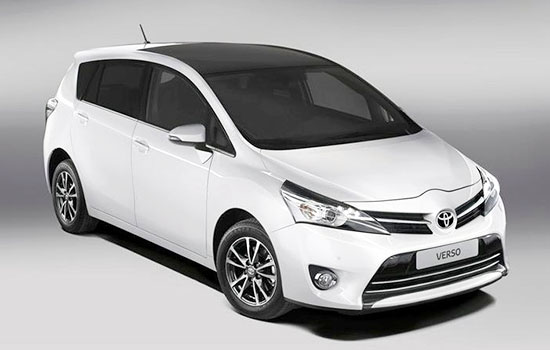
The Toyota Verso was a compact MPV that Toyota produced from 2009 to 2018 as the successor to the Corolla Verso, available with five or seven seats and sold in Europe, Morocco, South Africa, China and Israel. Production and European sales ended in 2018, so there was no 2019 Toyota Verso and no 2019 model year; the last cars were the facelifted AR20 model, and any vehicle advertised as a 2019 Verso would not be a factory model. This article covers what the Verso was, its final-generation specifications, and why it disappeared.
What the Verso Was
The Verso was a compact multi-purpose vehicle, a category of car that mixes the footprint of a compact hatchback with the seating and packaging of a small van. It replaced the Corolla Verso and was positioned above the smaller Verso-S and Space Verso in Toyota’s European range. It was never sold in Japan, and it was not offered in North America, where Toyota sold the similar Matrix instead. A Chinese-market version, badged Toyota E’Z, was built by GAC Toyota in Guangzhou from 2011 to 2017.
Interior and Seating

The Verso came in five- and seven-seat configurations, with the third row folding flat into the floor when not needed. The cabin was designed around family use, with multiple storage compartments and a sliding, split-folding second row on seven-seat versions to improve access to the rearmost seats. It used a conventional dashboard layout shared in spirit with the contemporary Corolla and Auris, rather than the high seating position of an SUV.
Exterior and Dimensions
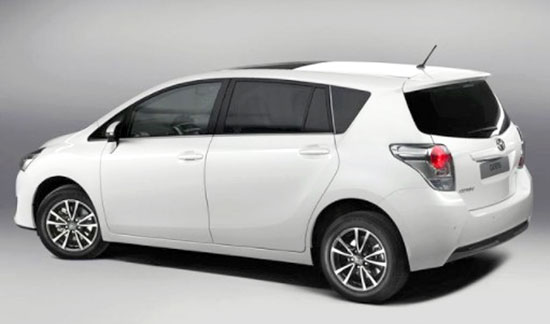
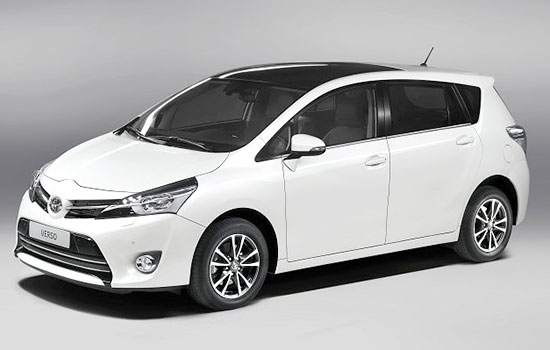
The Verso measured 4,440 to 4,450 mm (174.8 to 175.2 in) long, 1,790 mm (70.5 in) wide and 1,620 to 1,640 mm (63.8 to 64.6 in) tall, on a 2,780 mm (109.4 in) wheelbase. Its boxy, upright body was chosen to maximize interior space within those compact external dimensions. A facelifted version revealed at the 2012 Paris Motor Show adopted a front end similar to the E180 Auris, and was designed by Mehmet Kiliç of Toyota ED2.
Engines and Transmission

The Verso was offered with a range of gasoline and diesel four-cylinder engines. Gasoline choices were a 1.6-liter 1ZR-FE and a 1.8-liter 2ZR-FE, both using Toyota’s Valvematic variable valve system. Diesels comprised a 1.6-liter 1WW D-4D, a 2.0-liter 1AD-FTV D-4D and a 2.2-liter 2AD-FTV D-4D, plus a 2.2-liter 2AD-FHV D-CAT unit. Transmissions were a six-speed manual or Toyota’s Multidrive S continuously variable transmission, and drive went to the front wheels only. In South Africa the only diesel offered was the 2.0-liter D-4D.
Safety
The Verso was tested by Euro NCAP in 2010 and received an overall five-star rating, with 89 percent for adult occupant protection, 75 percent for child occupant protection, 69 percent for pedestrian protection and 86 percent for safety assist. At the time Toyota described it as a strong result for the compact MPV class. Standard equipment across the range included electronic stability control, anti-lock brakes and multiple airbags.
Why It Was Discontinued
The Verso fell victim to the shift in European buyer demand from MPVs to SUVs. Toyota sold only 821 Versos in the first half of 2018, a fraction of the roughly 3,921 RAV4s it sold in the same period, and European sales had fallen sharply from a peak of about 37,679 in 2010 to 6,633 in 2018. Toyota confirmed that the move away from the compact MPV segment drove the decision, and the model was withdrawn from sale across Europe in 2018. Production had effectively wound down by then, leaving only dealer stock.
What Replaced the Verso
Toyota did not build a direct replacement for the Verso. Instead, the brand pointed buyers toward its growing line of SUVs and crossovers, such as the RAV4 and C-HR, as well as the ProAce Verso and, later, the ProAce City for those who wanted a van-based people carrier. The Verso’s sales figures underline how completely the market had moved on: registrations in Europe fell from tens of thousands a year to just 45 in 2019. See the related 2019 Toyota Vitz Redesign and Release Date in our Car Review section.
Markets and Sales
The Verso’s strongest year in Europe was 2010, when about 37,679 were sold, and it remained a steady seller through the mid-2010s before declining sharply. In China the related E’Z sold around 16,000 to 17,000 units a year between 2011 and 2014 before fading. In South Africa the Verso was offered with the 2.0-liter diesel, and it was also marketed in Morocco and Israel. Toyota never offered the Verso with all-wheel drive or a hybrid powertrain.
The Verso Name and Toyota’s MPV Family
The name Verso was taken from the word versatility, reflecting the model’s flexible seating and load space. It belonged to a family of Toyota people carriers that also included the smaller Verso-S and the larger Avensis Verso, and it shared its New MC platform and much of its engineering with the Corolla and Auris of the period. The Chinese-built E’Z version used the same body with local trim and badging.
Buyers chose the Verso mainly for its combination of compact external size and up to seven seats, a formula that had made the Corolla Verso popular in the 2000s. By the time the AR20 Verso reached the end of its life, however, European families had largely switched to crossover SUVs, which offered a similar footprint with a higher driving position and, increasingly, hybrid power that the Verso never received.