The Toyota Yaris Hybrid is a full-hybrid version of Toyota’s subcompact hatchback, sold in Europe and Japan rather than the United States. For the 2019 model year it was the hybrid variant of the third-generation, XP130-series Yaris, a car that had been on sale since 2012 and was approaching the end of its life cycle. Toyota has offered a hybrid Yaris in Europe since 2012, and over that period it became one of the region’s best-selling hybrid cars.

Where the Yaris Hybrid Is Sold
Toyota sells the Yaris Hybrid mainly in Europe and Japan. It is not offered in the United States or Canada, where the Yaris of this era was a Mazda2-based car with no hybrid option. Buyers in North America looking for a small Toyota hybrid have instead had the Prius c and, later, the Corolla Hybrid. In Europe the hybrid took a large share of Yaris sales because it was priced close to the diesel and gasoline versions while offering markedly lower fuel consumption.
XP130 Hybrid Powertrain
The XP130 Yaris Hybrid pairs a 1.5-liter Atkinson-cycle gasoline engine with an electric motor in Toyota’s Hybrid Synergy Drive system. There is no conventional gearbox: power from the engine and motor is blended through a planetary gear set and sent to the front wheels by an electronically controlled continuously variable transmission. The engine, coded 1NZ-FXE, is based on the engine block of the second-generation Prius but was re-engineered for the smaller car.
| Component | Type | Output | Torque | Transmission |
|---|---|---|---|---|
| Gasoline engine (1NZ-FXE) | 1,497 cc I4, Atkinson cycle | 55 kW (74 hp) @ 4,800 rpm | 111 Nm | – |
| Electric motor | Permanent-magnet synchronous | 45 kW | 169 Nm | – |
| Combined system | – | 74 kW (100 hp) | – | e-CVT |

Fuel Economy and Emissions
The Yaris Hybrid was engineered for low fuel consumption. Toyota quoted an average of 3.5 l/100 km (about 67 mpg US) on the then-current test cycle, with CO2 emissions of 79 g/km at launch. Because the car can run on electric power alone at low speeds, it uses little or no fuel in slow city traffic, which is where it differs most from a conventional gasoline supermini. Combined with a 36-liter tank, that gave a claimed driving range of around 1,000 km on a single fill.
Battery and Packaging
The hybrid system uses a 144-volt nickel-metal hydride battery with 120 cells, mounted under the rear passenger seats so that luggage space is unaffected. Trunk capacity matches the non-hybrid Yaris at 286 liters. The complete hybrid system weighs 201 kg, which Toyota said was about 20 percent lighter than the Auris Hybrid’s, a substantial saving in a car of this size. Toyota reduced the number of battery cells and moved both the battery and fuel tank under the rear seat to avoid intruding on the cabin or cargo area.
Dimensions and Performance
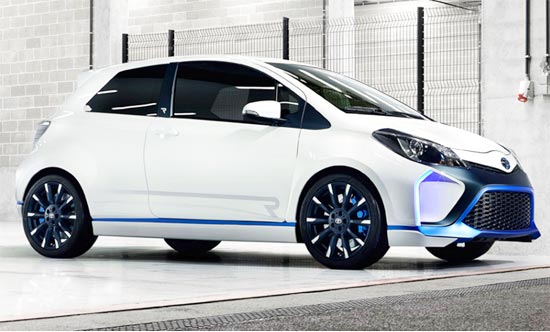
The XP130 Yaris Hybrid is a five-door hatchback. It accelerates from 0 to 100 km/h in 11.8 seconds and has a top speed of 165 km/h, figures that reflect its focus on efficiency rather than speed. Its compact size, light steering and electric-assisted low-speed running make it well suited to city driving, where the hybrid system operates on battery power most often.

Driving and Ownership
Because there is no clutch or torque converter, the Yaris Hybrid pulls away smoothly and quietly on electric power, and the engine starts and stops automatically as needed. That behavior is why the car is particularly economical in stop-start traffic. Real-world consumption varies with the driver and conditions, but the model has a strong reputation for reliability, and Toyota’s hybrid components are covered by an extended warranty in many markets, often up to 15 years for the battery with regular dealer servicing.
The 2020 Successor
Toyota replaced the XP130 Yaris with the fourth-generation XP210 model in 2020, which brought a new 1.5-liter three-cylinder hybrid built on the TNGA platform. In its standard form that car makes 116 hp, and a more powerful 130 hp version followed later. The newer model is more efficient and quicker than the XP130 hybrid, but the earlier car remains widely available on the used market and is generally cheaper to buy.
Buying a Used Yaris Hybrid
For buyers today, the 2019 Yaris Hybrid is a used car, and the main variable is battery condition. Because the hybrid battery is a wear item, it is worth having its health checked before purchase, although Toyota hybrid packs of this generation have proved long-lived. Service history, mileage and accident record matter as much as they do on any other car. Related Toyota coverage includes the 2019 Toyota Yaris Review and the 2019 Toyota Avanza Philippines Review and Release.

How It Compares With a Conventional Yaris
Against a gasoline or diesel Yaris of the same era, the hybrid traded a little top-end performance for much better urban fuel economy. It was heavier than the non-hybrid by roughly the weight of the battery pack, but the instant torque of the electric motor made it feel quicker away from traffic lights. Buyers who covered a lot of city miles gained the most, because the engine could shut down and the car could creep on electric power alone in slow traffic.
Safety and Equipment
Later XP130 Yaris models, including the 2018-2020 facelift cars, could be specified with Toyota Safety Sense, which added pre-collision warning, lane departure alert and automatic high beams. Inside, equipment depended on grade but typically included air conditioning, a touchscreen infotainment system and Bluetooth connectivity, along with a full set of airbags and electronic stability control as standard.
European Market Position
In Europe the Yaris Hybrid was central to Toyota’s push to sell hybrid cars at volume rather than as niche models. It was priced close to conventional superminis and came with automatic transmission as standard, since the hybrid system has no manual option. That combination appealed to urban buyers who wanted low running costs without switching to diesel, and it helped make the Yaris one of the region’s most popular hybrids.