There was no 2020 Toyota Avensis. Toyota built the Avensis from October 1997 until August 2018, when production ended at its Burnaston plant in Derbyshire, United Kingdom. The model was developed for Europe and was never sold in North America. Buyers who wanted a new Toyota in the Avensis’s size after 2018 had to turn to the Camry, which Toyota reintroduced to Europe as the model’s successor.

What the Avensis Was
The Avensis was a mid-size family car in the European D-segment, the class that includes the Ford Mondeo, Volkswagen Passat and Opel Insignia. Its name comes from the French word avancer, meaning to advance or move forward. It replaced the Carina E and was the first Toyota designed specifically for the European market. Body styles included a four-door sedan, a five-door liftback in the first two generations, and a five-door estate. The Avensis was not related to the North American Camry of the same era, although it competed in a similar space.
The Three Generations
The Avensis ran through three generations, all built at Burnaston in the United Kingdom.
- First generation (T220), 1997–2003: launched with 1.6-, 1.8- and 2.0-liter gasoline engines and a 2.0-liter turbo-diesel; facelifted in 2000.
- Second generation (T250), 2003–2009: a larger car on a longer 2,700 mm wheelbase, with new VVT-i gasoline and D-4D diesel engines.
- Third generation (T270), 2009–2018: the final model, facelifted in 2012 and 2015 and the only generation with Valvematic gasoline engines.
Across all three generations, Toyota built just under two million Avensis cars at Burnaston, making it one of the most significant models Toyota ever produced in Europe.
Toyota revised the final generation several times. The 2012 facelift adjusted the styling, aerodynamics and emissions, and a further update in 2015 simplified the UK engine range down to a single 1.8-liter Valvematic gasoline plus a pair of new Euro 6 diesels. The liftback body style was dropped when the third generation arrived in 2009, leaving the sedan and estate only.

Engines and Powertrains
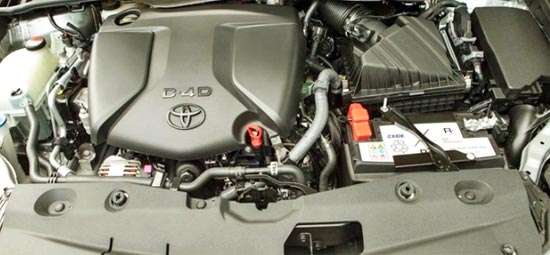
The final generation offered Valvematic gasoline engines of 1.6, 1.8 and 2.0 liters and a range of D-4D diesel engines from 1.6 to 2.2 liters. Diesel outputs ran from about 110 to 174 horsepower. A six-speed manual gearbox was standard, while the 1.8- and 2.0-liter petrols could be ordered with Toyota’s Multidrive S continuously variable transmission (CVT), and the 2.2-liter diesel was offered with a six-speed automatic. Later cars added a BMW-sourced 1.6-liter diesel as Toyota phased out the older 2.0-liter unit.

Interior and Comfort
The Avensis was tuned for comfort and quiet cruising rather than sporty handling, which suited its role as a long-distance car for families and company drivers. Interior space was generous for the class, and the estate version in particular offered a large, practical load area. Toyota fitted the third-generation car with an electric parking brake, and top trims included navigation, leather upholstery and a reversing camera.
Why It Was Discontinued
The Avensis was a strong seller in its early years, with European sales peaking at 142,535 units in 2004. Demand for large sedans and estates then declined as buyers moved toward SUVs, and sales fell to roughly 25,319 units across Europe in 2017. Toyota ended UK sales in August 2018 and wound the model down across Europe later that year.
What Replaced It
The Avensis’s role was partly taken by the XV70 Camry, which returned to the European market in 2019 after a long absence and is based on the modern TNGA-K platform. Toyota also offered the Corolla family, including the Corolla sedan and the Touring Sports wagon, as the natural step up for buyers who previously shopped the Avensis.
Toyota never launched a direct successor carrying the Avensis badge, and the nameplate ended with the final T270 car. For European buyers, the Camry and Corolla filled the gap: the Camry took the larger, more premium slot, while the Corolla covered the volume end of the C- and D-segments with sedan, hatchback and wagon bodies.
Buying an Avensis Today
Because the model was popular with company fleets, used Avensis cars remain widely available in the UK and mainland Europe. Examples built between 2009 and 2018 share the final generation’s mechanical package, and parts and servicing are supported through Toyota’s European dealer network. The wagon is the most sought-after body style for buyers who need cargo space.
The Avensis Verso
Toyota also used the Avensis name on an MPV, the Avensis Verso. Introduced in 2001, it seated seven and shared only its 2.0-liter gasoline and diesel engines with the sedan. The Verso was sold in some markets under the Ipsum or Picnic names and stayed on sale alongside the second-generation Avensis until 2006.
Avensis in Motorsport
The Avensis had a second life in touring-car racing. In 2010 it was announced that the British Touring Car Championship’s NGTC prototype would be built around the Avensis, and the car was subsequently campaigned by Speedworks Motorsport, driven by Tom Ingram, through the end of the 2018 season.
Why Buyers Chose It
The Avensis built its reputation on durability and low running costs rather than driving excitement. Its conservative dynamics, spacious cabin and strong reliability record made it a common choice for families and fleet operators, and it was consistently among Toyota’s best-selling models in Europe during the 2000s.