The Toyota Aygo is the smallest car Toyota sells in Europe, and the 2020 model year belongs to the second-generation AB40 series. That generation ran from 2014 to 2022 and shared its underpinnings and its Czech factory with the Citroën C1 and Peugeot 108. The 2020 Aygo carried over the styling and engines introduced at the 2018 Geneva Motor Show facelift, so it was an established car rather than a brand-new one.

What the 2020 Aygo Was
The Aygo is a three- or five-door city car aimed at urban buyers in the A-segment. The first generation appeared in 2005 as part of a joint venture called Toyota Peugeot Citroën Automobile, built in Kolín in the Czech Republic. The second generation, launched in 2014, kept the same partnership and the same factory. Its compact dimensions make it one of the easiest new cars to park and maneuver in European cities.
The 2018 Facelift
The styling and engineering update that defined the late AB40 cars was unveiled at the 2018 Geneva Motor Show. It introduced the large, three-dimensional “X” front treatment, a new lower bumper with glossy black or silver inserts, and LED light guides in the rear lamps. Two new paint colors, Magenta and Blue, joined the range, and piano-black C-pillars created a floating-roof look. Inside, Toyota redesigned the gauges, added piano-black and quartz-gray trim, and fitted a seven-inch touchscreen with smartphone connectivity on most trims. The 2020 model carried these changes forward unchanged.
Engine and Efficiency
The Aygo used a 1.0-liter three-cylinder gasoline engine, code 1KR-FE, with variable valve timing. It produced 72 PS (71 hp) at 6,000 rpm and 93 Nm (69 lb-ft) of torque, and drove the front wheels through either a five-speed manual or a five-speed automated manual gearbox. An Eco version used longer fourth and fifth gear ratios to cut fuel consumption. The engine was updated for the facelift to meet the Euro 6c emissions standard. Performance is modest: 0-62 mph takes about 13.8 seconds and the top speed is around 159 km/h (99 mph).
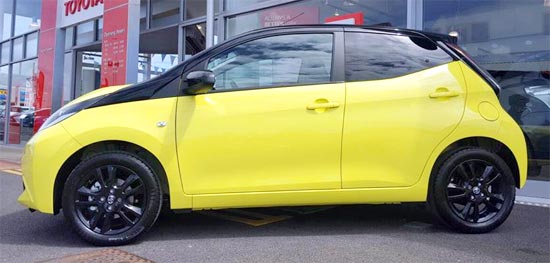
Exterior
The Aygo is short and tall, with a wheelbase of 2,339 mm (92.1 in) and an overall length of 3,465 mm (136.4 in). It is 1,615 mm (63.6 in) wide and 1,461 mm (57.5 in) tall, with short overhangs that make it feel agile in town. The front is dominated by the X-shaped grille and headlight cluster, one of the most distinctive faces in the segment, and the rear is marked by the vertical LED light guides introduced for 2018.

Interior
The cabin is simple and functional, with fabric seats, a compact dashboard and a central touchscreen on higher grades. Front-seat space is reasonable for two adults, while the rear bench is best suited to short trips or children. The trunk holds about 167 liters, enough for shopping or a couple of small cases, and the rear seatback folds to expand the space. Higher trims added automatic climate control, smart entry and part-leather upholstery.

The Aygo X and the End of the AB40
The AB40 generation was replaced in March 2022 by the Toyota Aygo X, a taller, crossover-styled model built by Toyota alone after the C1 and 108 ended production. That change marked the end of the joint venture that had produced all previous Aygos. Because the 2020 model sits before that transition, it uses the shared platform rather than the Aygo X’s dedicated Toyota hardware. Buyers comparing small Toyotas can read the 2020 Toyota Yaris Gazoo Interior, Release Date and Price, and those looking further up the range can see the 2020 Toyota Crown Redesign, Review.

A Brief Aygo History
The first-generation Aygo (AB10) went on sale in 2005 and was facelifted twice, in 2009 and 2012, before being replaced in 2014. All three cars in the joint venture shared the same body structure and mechanicals, differing mainly in styling and trim. The second generation that includes the 2020 car kept the three-cylinder engine but grew slightly and gained a stronger design identity built around the X-shaped front end.
Trim Levels and Equipment
Toyota sold the Aygo in a set of named grades, including x, x-play, x-press, x-style and x-pression. The base x model included electric front windows, electric door mirrors and daytime running lights. Moving up the range added manual or automatic air conditioning, Bluetooth, steering-wheel controls, 15-inch alloy wheels, part-leather seats, the seven-inch x-touch multimedia system, DAB radio, front fog lights and a reversing camera. The broad trim spread let buyers personalize a small car more than is typical in the segment.
Running Costs and Practicality
With a small 1.0-liter engine and a light body, the Aygo is inexpensive to fuel, insure and tax, which is central to its appeal in Europe. A 34.8-liter (9.2 US gal) fuel tank and a low drag coefficient of 0.28 help stretch each fill-up. The main practicality limits are the small trunk, the tight rear seat and modest refinement at higher speeds, all of which are normal for an A-segment city car. Toyota’s reliability record was a further draw for urban and fleet buyers.
Colors and Personalization
Personalization was a selling point for the Aygo. The 2018 update added Magenta and Blue to the paint palette, and the floating-roof effect created by the piano-black C-pillars could be combined with a contrasting roof color. Buyers could also choose between steel wheels with covers and alloy wheels depending on grade, while front bumpers were finished with glossy black or silver inserts. This range of combinations gave the small car a degree of visual customization unusual among low-cost city cars.