The Toyota Fortuner is a mid-size, body-on-frame SUV that Toyota has built since 2004. It is sold across Asia, Africa, South America, the Middle East and Australia, where in some markets it carries the SW4 badge, and it is closely related to the Hilux pickup and the Innova MPV under Toyota’s IMV program. A 2020 Fortuner genuinely exists: the second-generation model, introduced in July 2015, received its first facelift for the 2020 model year. This article reviews that vehicle and the engines that powered it.

What the Fortuner Is
The Fortuner is built on the same ladder-frame chassis as the Hilux pickup, which gives it genuine off-road capability and towing ability rather than the car-based construction of a crossover. It offers seating for up to seven across three rows, with the rearmost pair folding away to the sides rather than into the floor. Power reaches the road through rear-wheel drive or a part-time four-wheel-drive system. The name is derived from the English word “fortune”. Toyota positions the Fortuner beneath the Land Cruiser Prado and the 4Runner in markets where those models are also sold; the American-market TRD Pro version of the related 4Runner is covered in our 2019 Toyota 4Runner TRD Pro Review.
Because it is engineered for durability in emerging markets, the Fortuner prioritizes mechanical simplicity and parts availability over luxury. It shares its basic architecture with the Innova, a lower-cost MPV, and with the Hilux, which means service knowledge is widespread wherever Toyota sells those vehicles. Sales run into the hundreds of thousands globally each year, spread across more than a dozen assembly plants.
Origins and Generations
The first-generation Fortuner went into production in November 2004 in Thailand and was also assembled in Argentina, India, Indonesia, Malaysia, Venezuela, Vietnam and Pakistan, among other locations. It was the indirect replacement in some markets for the Hilux Sport Rider and, in others, for the 4Runner. The second generation, coded AN150 for four-wheel-drive models and AN160 for two-wheel-drive versions, began production in July 2015 and remains in production. Development of the second-generation car was led by Toyota Australia, which also worked on the related Hilux and Innova.
The platform is a body-on-frame design using the Toyota IMV architecture, with a live rear axle and, on four-wheel-drive models, a dual-range transfer case. This is the same approach Toyota uses for the Land Cruiser Prado, and it explains why the Fortuner is often compared with other pickup-based SUVs rather than with car-derived crossovers. The 2019 Toyota Fortuner Price and Review covers the model year immediately before the update described here.
Cabin and Interior
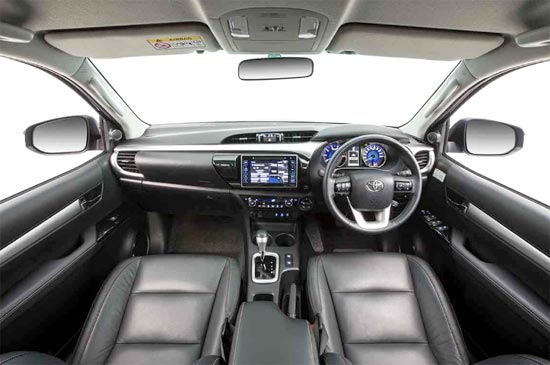
The Fortuner’s cabin is designed around durability rather than opulence, though higher trims add plenty of equipment. The 2020 facelift brought a redesigned instrument panel and an upgraded audio system. Because the model is a three-row SUV, the interior arrangement matters as much as the materials: the third row folds to the sides of the cargo area, leaving a flat load floor in the middle row. Feature levels vary widely by market, with top trims offering touchscreen infotainment, smartphone connectivity, keyless entry and automatic climate control.
Dimensions and Exterior
The second-generation Fortuner measures 4,795 mm (188.8 in) long, 1,855 mm (73.0 in) wide and between 1,835 and 1,850 mm (72.2–72.8 in) tall, on a 2,750 mm (108.3 in) wheelbase. Curb weight ranges from about 1,850 to 2,135 kg (4,079–4,707 lb) depending on engine, drivetrain and equipment. Compared with the first generation, the body is longer, wider and lower, and the car rides on 17- or 18-inch wheels depending on trim. The 2020 update added a larger grille, new headlights and redesigned bumpers and wheels.

Engine Options
The second-generation Fortuner has been offered with a broad range of engines depending on market: a 2.7-liter 2TR-FE four-cylinder gasoline unit and a 4.0-liter 1GR-FE V6 on the gasoline side, and 2.4-, 2.5-, 2.8- and 3.0-liter four-cylinder turbo-diesels on the other. The mainstream choices are the 2.4-liter 2GD-FTV and the 2.8-liter 1GD-FTV diesels, both of which drive through a five- or six-speed manual or a five- or six-speed automatic transmission.
At the time of the 2020 facelift, the Bangkok Post reported that Toyota had retuned the 2.8-liter diesel to produce 204 hp (152 kW) and 500 N⋅m of torque, up from 177 hp and 450 N⋅m, with peak torque available from 1,600 to 2,800 rpm. The 2.4-liter unit was quoted at 163 hp (121 kW) and 400 N⋅m. Toyota said fuel economy was not harmed by the power increase, claiming 13.9 km/L for the 2.8-liter with the automatic gearbox and four-wheel drive.

The 2020 Update and Pricing
For the 2020 model year Toyota gave the Fortuner its first facelift since launch, with new grille, headlights, bumpers and wheel designs, plus the revised instrument panel. Toyota also introduced a more luxurious Legender variant in Thailand, offering the uprated 2.8-liter diesel. The Bangkok Post reported Thai prices from 1.564 to 1.839 million baht across four Legender trims, and 1.319 to 1.414 million baht for the three standard variants with the 2.4-liter engine. Seven airbags were made standard across the range, and the Legender added driver-assistance features including adaptive cruise control and lane-keep assist.

Buying a Used Fortuner
The Fortuner competes with other pickup-based SUVs such as the Mitsubishi Pajero Sport, Isuzu MU-X, Nissan Terra and Ford Everest. Its strengths are durability, resale value and parts availability in the markets where it is sold. Buyers considering a used example should check the four-wheel-drive system if fitted, confirm diesel service records, and inspect the underside for corrosion and off-road damage. It is not sold in Japan or the European Union, so availability is concentrated in the emerging markets where Toyota builds and retails it. An overview of the wider range is available in our Toyota Review section.