Toyota did not build a 2021 Yaris Hatchback for the United States. The nameplate was retired there after the 2020 model year, and production of the Mazda2-based Yaris sedan and hatchback ended in June 2020. A redesigned Yaris did appear for 2020, but it was the fourth-generation car sold in Japan, Europe and Australasia, and it never reached North America. The genuinely useful question, then, is what that redesign was and what buyers can actually get.
The Record on the U.S. Yaris
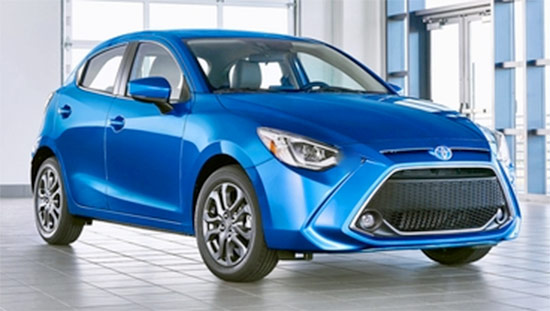
Toyota confirms on its discontinued-vehicle page that both the Yaris and Yaris Hatchback ended with the 2020 model year. The final U.S. hatchback was a rebadged Mazda2 with a 1.5-liter four-cylinder making 106 horsepower, a six-speed automatic and front-wheel drive. It was a one-year model for 2020 and was not carried into 2021, so a “2021 Yaris Hatchback redesign” for the U.S. market did not exist. In Canada and Mexico, sales ended around the same time.
The Real 2020 Redesign: The Fourth-Generation Yaris
The genuine redesign was the XP210-series Yaris, unveiled on October 16, 2019 and launched in Japan on February 10, 2020, with European sales starting in July 2020. It moved to the GA-B platform within Toyota’s TNGA family, the first compact car to use it, improving rigidity and lowering the center of gravity. The standard body is a five-door hatchback; the three-door body is reserved for the performance GR Yaris.
Interior
The fourth-generation Yaris is a compact B-segment hatchback. In Europe it measures about 155.1 inches long, 68.7 inches wide and 57.9 inches tall, with a wheelbase of 100.8 inches, while Japanese-market cars are narrower to qualify as compact cars under local rules. The cabin gained a touchscreen infotainment system with smartphone mirroring, and higher trims added features such as a head-up display.

Exterior
The redesign gave the Yaris a shorter, wider and lower stance than its predecessor, with a large grille, slim headlights and, on higher grades, two-tone paint. In Europe it was offered with a 1.5-liter hybrid as the principal powertrain and, in some markets, 1.0- and 1.5-liter conventional gasoline engines.

Engine and Hybrid Powertrain
| Engine | Type | Output |
|---|---|---|
| 1.0-liter (1KR-FE) | Three-cylinder gasoline | about 69 hp |
| 1.5-liter (M15A-FKS) | Three-cylinder gasoline | about 118-123 hp |
| 1.5-liter hybrid (M15A-FXE) | Three-cylinder gasoline plus electric motor | about 116 hp combined |
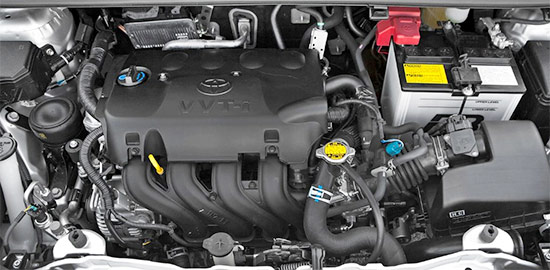
The hybrid pairs a 1.5-liter three-cylinder engine with an electric motor and a lithium-ion battery, driving the front wheels through a power-split transmission. Toyota quoted WLTP combined fuel economy of up to about 68.8 mpg (4.1 liters per 100 km) in Europe, and 0-100 km/h in around 9.7 seconds for the standard hybrid.
The fourth-generation Yaris was assembled in Japan at Kanegasaki and, for Europe, at Toyota’s Onnaing plant in France from July 2020, with a second European site in Kolin, Czech Republic, added in November 2021. In Australia and New Zealand it went on sale from August 2020, sourced from Japan. Because it was never a U.S. model, there was no American release date or price for a 2021 Yaris Hatchback.

In Europe the fourth-generation Yaris measures 3,940 mm long, 1,745 mm wide and 1,470 mm high on a 2,560 mm wheelbase, while Japanese and Australasian cars are 1,695 mm wide on a 2,550 mm wheelbase. Curb weight ranges from about 940 to 1,180 kg depending on engine and drivetrain.
Toyota quoted WLTP combined fuel economy of up to about 68.8 mpg (4.1 liters per 100 km) for the fourth-generation Yaris Hybrid in Europe, with CO2 emissions as low as 92 g/km in the most efficient form. The hybrid is the volume powertrain in Europe.
In the U.S., the 2020 Yaris carried Toyota’s standard 36-month or 36,000-mile basic warranty and a 60-month or 60,000-mile powertrain warranty. The fourth-generation Yaris sold elsewhere was covered by Toyota’s regional warranties, which vary from market to market.
The gap between the two cars is stark. The U.S. Yaris Hatchback was a 106-hp Mazda2 in Toyota badges with a limited driver-assistance suite, while the global fourth-generation Yaris introduced a new platform, a three-cylinder hybrid and a full safety package. They shared only the name.
Safety and Awards
The fourth-generation Yaris earned a five-star Euro NCAP rating in 2020 and a five-star ANCAP rating in Australia, and it was named 2021 European Car of the Year. Toyota’s Safety Sense package was fitted in most markets, bringing a pre-collision system with pedestrian and cyclist detection, lane tracing assist and adaptive cruise control. This was a substantial step up from the Mazda2-based U.S. car, which had only a limited driver-assistance suite.
The GR Yaris
The performance flagship of the family is the GR Yaris, a three-door homologation special for the World Rally Championship. It uses a turbocharged 1.6-liter three-cylinder engine that produces roughly 257 to 268 horsepower depending on market, a six-speed manual and GR-Four all-wheel drive, and it went into production in September 2020 at Toyota’s Motomachi plant. Toyota did not offer it in the United States or Canada either.
Rivals and What Buyers Can Get Today
In Europe the fourth-generation Yaris competes with the Ford Fiesta, Renault Clio, Volkswagen Polo and Honda Jazz. In the U.S., the alternatives are the Corolla Hatchback and Toyota Certified used Yaris models from 2020 and earlier. Elsewhere, the fourth-generation Yaris and its hybrid are widely available used. Those interested in Toyota’s other small cars can read the 2020 Toyota Vios Review or the 2020 Toyota Alphard Hybrid Review, and browse more at Toyota Review.
Used examples of the fourth-generation Yaris are common in Europe and Australasia, where the hybrid dominates the line-up, whereas a U.S. buyer will only find the Mazda2-based 2020 car or an earlier XP130 hatchback.