2027 Honda Super One EV: Ultra-Compact Urban Electric Runabout Specs and Global Launch
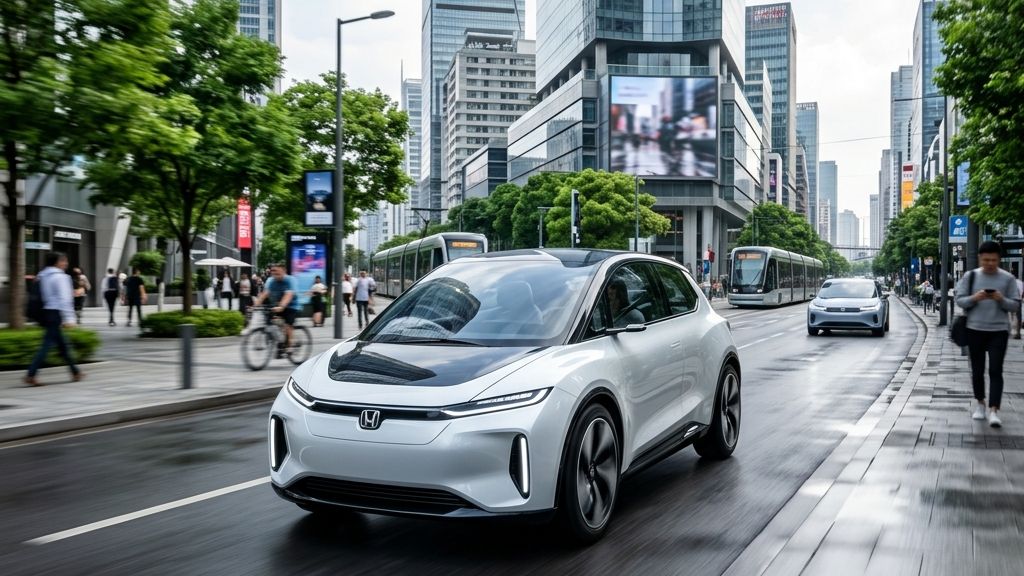
The 2027 Honda Super One EV is shaping up to be one of Honda’s most characterful electric cars: a tiny, city-focused hatchback engineered to deliver more personality than its modest footprint might suggest. Developed from the Super EV Concept and subsequently shown in prototype form, the Super One combines Honda’s Japanese kei-car expertise with a wider body, rear-wheel-arch extensions, a driver-focused cabin, and an unusual simulated transmission experience.
Rather than chasing enormous battery packs, record-breaking acceleration, or luxury-SUV dimensions, Honda is using the Super One to explore a more accessible side of electric mobility. Its mission is simple but relevant: make an urban EV easy to place on crowded roads, inexpensive to operate, practical enough for daily errands, and entertaining at speeds drivers can realistically use.
The “2027” designation should be treated primarily as a likely model-year reference for certain export markets. Honda has indicated a staged introduction beginning in Japan, followed by selected markets including the United Kingdom and parts of Asia. Exact specifications, prices, market names, and launch dates remain subject to regional confirmation.
From Kei-Car Thinking to a Global Urban EV
Honda has decades of experience building space-efficient Japanese minicars. Models such as the N-BOX and N-ONE demonstrate how an upright roof, wheels pushed toward the corners, and carefully packaged interior components can turn a very small road footprint into a genuinely useful passenger compartment.
The Super One applies that philosophy to an electric performance-oriented runabout. Its underlying engineering is closely associated with Honda’s compact N Series EV development, but the widened bodywork distinguishes it from a strictly Japanese-market kei car. Pronounced wheel arches increase visual stance and may accommodate a broader track and larger tires, changes that can improve cornering stability while giving the car a tougher appearance.
This approach contrasts sharply with Honda’s larger vehicles. Buyers needing three rows, substantial cargo capacity, or rough-road capability would be better served by the 2027 Honda Pilot Black Edition: Three-Row Utility, Trail Driving Modes, and Panoramic Roof. The Super One instead targets solo commuters, couples, urban households, and multi-car families seeking a compact second vehicle.
Expected Specifications and Technical Outlook
Honda has not published a complete production specification sheet for every Super One market. Consequently, battery capacity, rated power, official range, charging speed, and final dimensions should not be presented as settled facts. The most reliable picture combines Honda’s prototype disclosures with the known priorities of its compact EV program.
| Category | 2027 Honda Super One EV Outlook | Status and Context |
|---|---|---|
| Vehicle type | Ultra-compact battery-electric hatchback | Core production concept confirmed |
| Drive layout | Single-motor electric drivetrain | Final motor output varies by market |
| Battery | Compact lithium-ion traction battery | Capacity not globally confirmed |
| Performance feature | Boost Mode with enhanced response and synthesized sound | Demonstrated on the prototype |
| Transmission experience | Simulated seven-speed shifting | Software-created; not a mechanical gearbox |
| Charging | AC home charging and expected DC rapid-charging support | Connector and rate depend on region |
| Primary use | Urban commuting, local travel, and short regional trips | Efficiency prioritized over long-distance range |
| Launch outlook | Japan first, followed by selected Asian and European markets | Timing and branding require local confirmation |
Battery Range and Charging Expectations
A small EV does not need an SUV-sized battery to be useful. Reduced mass, limited frontal area, and city-speed operation can produce competitive efficiency from a relatively compact pack. A smaller battery also requires fewer raw materials, costs less to manufacture, and can recharge overnight from ordinary domestic equipment more easily than a high-capacity luxury-EV battery.
Honda has not confirmed a universal Super One range figure. Real-world results will depend on wheel size, climate-control use, speed, temperature, and regional test cycles. Frequent motorway driving in cold weather will consume energy much faster than low-speed urban travel. Prospective owners should therefore judge the car by their normal daily mileage rather than focusing only on a laboratory range number.
This is a fundamentally different proposition from the 2027 Acura ZDX EV: Performance Electric SUV Changes, Air Suspension, and Real-World Range, which represents a larger, heavier, more powerful interpretation of electric mobility. The Acura is better suited to premium long-distance travel; the Honda’s strengths are compactness, efficiency, and maneuverability.
Boost Mode and the Simulated Seven-Speed Gearbox
The Super One’s headline feature is Boost Mode. Honda says this setting sharpens the powertrain’s response while coordinating simulated gearshifts and an active sound profile. Although an electric motor does not require a conventional multi-ratio transmission, software can vary torque delivery to create stepped acceleration. The driver receives distinct shift sensations rather than one uninterrupted surge.
Purists may question whether synthesized sound and virtual gears are necessary. From an efficiency perspective, they are not. From an engagement perspective, however, they could give the Super One an identity missing from many small EVs. Honda’s challenge is to make the system feel responsive and coherent rather than artificial. Drivers should also be able to select a calmer mode when they want quiet, seamless transportation.
The concept resembles a compact electric hot hatch more than a stripped-down economy appliance. Immediate low-speed torque, a low-mounted battery, and short overall dimensions should make it agile in tight corners. Peak output matters less here than accelerator calibration, steering consistency, brake-pedal blending, and body control over imperfect urban pavement.
Exterior Packaging and Interior Practicality
The Super One’s upright silhouette maximizes usable cabin volume. Its short nose and near-vertical tail reduce wasted exterior length, while large windows should improve visibility at junctions and in parking structures. The widened arches provide visual drama without turning the vehicle into an oversized crossover.
Inside, the prototype emphasizes the driver with sport-inspired seats, a compact instrument display, physical controls, and dedicated performance functions. A production version will need to balance this playful character with everyday requirements such as smartphone integration, climate control, useful storage trays, charging-port information, and a clear energy-consumption display.
Rear-seat accommodation is likely to be best for children or occasional adult use, while cargo space should suit groceries and small luggage rather than bulky family equipment. Buyers wanting more rear-seat flexibility in a still-manageable footprint may prefer to investigate the 2027 Honda HR-V: Refresh Interior Screens, Hybrid Powertrain Expectations, and MSRP.
Urban Advantages
- A small turning circle should simplify U-turns, narrow streets, and multi-level parking garages.
- Compact dimensions reduce the stress of parallel parking and congested city driving.
- Instant electric torque supports confident departures from junctions and roundabouts.
- Regenerative braking can reduce friction-brake use during stop-and-go operation.
- Home charging may eliminate routine fuel-station visits for owners with off-street parking.
Safety, Ride Quality, and Ownership Considerations
Small cars must reconcile low mass and compact dimensions with modern crash standards. Market-specific equipment is expected to include automatic emergency braking, lane-departure assistance, traffic-sign recognition, parking sensors, and multiple airbags, but Honda must confirm the final package for each country. Buyers should avoid assuming that Japanese, British, and Asian versions will have identical assistance systems.
Ride comfort will be another important test. Short-wheelbase cars can feel busy over expansion joints, while large wheels and low-profile tires may amplify impacts. Careful spring, damper, and tire tuning will determine whether the Super One remains enjoyable on real streets rather than only on smooth demonstration routes.
Running costs should benefit from fewer drivetrain service items and efficient energy consumption, although insurance, tire pricing, battery warranty terms, and repairability remain important. Customers considering premium performance and all-weather capability at the opposite end of Honda’s portfolio can compare the 2027 Acura MDX Type S: Turbo V6 Super Handling All-Wheel Drive Refresh and Luxury Tech.
Global Launch, Naming, and Market Prospects
Honda’s rollout is expected to begin in Japan before extending to selected overseas markets. The Super One name may not be universal; Honda can adapt branding, equipment, charging hardware, and certification specifications to local requirements. Availability in the United Kingdom and parts of Asia appears central to the international plan, while a North American launch has not been firmly established.
The business case will depend heavily on price. Urban EV buyers are increasingly sensitive to monthly payments, charging access, insurance costs, and usable range. If Honda prices the Super One close to larger electric hatchbacks, its size could become a disadvantage. If it is positioned as an attainable, well-equipped city car with genuine driving character, it could occupy a distinctive niche.
Final Assessment
The 2027 Honda Super One EV: ultra-compact urban electric runabout specs and global launch story is compelling because the vehicle does not attempt to imitate a conventional crossover. It uses compact dimensions, EV packaging, widened bodywork, and software-generated performance features to create something more playful and specialized.
Several decisive figures remain unconfirmed, including battery capacity, motor output, certified range, charging speed, price, and market-by-market equipment. Even so, the underlying idea is clear. The Super One is intended to make electric driving approachable and entertaining in dense environments where enormous batteries and high top speeds provide little practical benefit. If Honda preserves the prototype’s personality while delivering a competitive price, comfortable ride, and credible charging capability, this diminutive EV could become one of the most memorable urban cars of the 2027 model-year period.