2027 Honda Super One EV: Ultra-Compact Urban Electric Runabout Specs and Global Launch
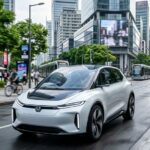
The 2027 Honda Super One EV is shaping up as a small electric car with an unusually large personality. Developed from Honda’s Super EV Concept and associated with the company’s compact N-series architecture, the production-oriented Super One is intended to make electric urban driving accessible, efficient, and entertaining. Instead of chasing enormous battery packs, four-figure horsepower outputs, or luxury-SUV dimensions, Honda is concentrating on low weight, a tiny footprint, responsive controls, and practical everyday range.
That approach makes the Super One particularly relevant in crowded cities where parking space, energy consumption, and purchase price matter more than cross-country performance. It also places the car in a different category from Honda’s larger family vehicles. Buyers needing three rows and all-weather versatility will be better served by models such as the 2027 Honda Pilot Black Edition: Three-Row Utility, Trail Driving Modes, and Panoramic Roof. The Super One, by contrast, is a focused electric runabout designed around short trips, narrow streets, and dense urban life.
Background: From Super EV Concept to Production Car
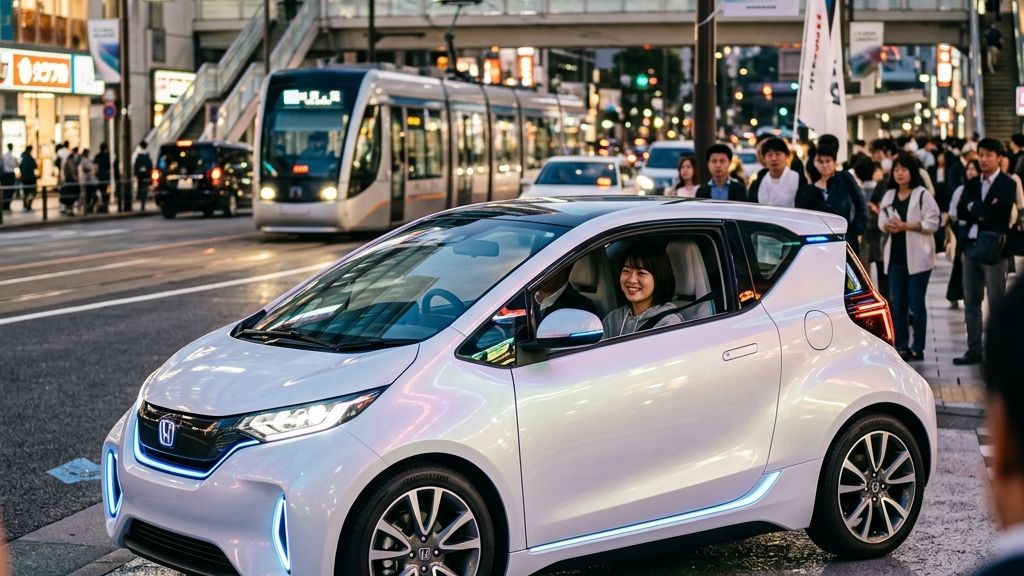
Honda previewed its small electric-car strategy through the Super EV Concept, a compact prototype tested on public roads in the United Kingdom and other locations. The concept’s tall cabin, short overhangs, wide-set wheels, and assertive fender treatment suggested that Honda did not want its entry-level EV to feel like an anonymous appliance. Its proportions drew from Japanese kei-car design, where strict dimensional limits have encouraged manufacturers to extract extraordinary interior utility from very little road space.
The Super One name is tied to the model’s international positioning, although Honda may use different branding or specifications in individual markets. In Japan, the vehicle is expected to remain closely connected to the N-series family of compact cars. Export versions can be adapted to local regulations, crash standards, charging hardware, and customer expectations. Wider bodywork or different battery configurations are possible outside the domestic kei category.
Honda has indicated a rollout beginning in 2026 in selected regions, making “2027 Honda Super One EV” a logical model-year description for vehicles reaching additional markets or entering their first full sales cycle. Japan, parts of Asia, and the United Kingdom have been central to launch discussions. Availability in continental Europe or other right- and left-hand-drive markets will depend on homologation, pricing, and Honda’s regional product plans.
2027 Honda Super One EV Preliminary Specifications
Honda has not published a complete global specification sheet covering battery capacity, motor output, certified range, charging speed, or final dimensions. Consequently, exact figures circulating before launch should be treated as estimates unless supported by regional certification documents. The following table separates the car’s known technical direction from details that remain provisional.
| Category | Expected 2027 Honda Super One EV Specification | Status and Context |
|---|---|---|
| Vehicle type | Ultra-compact five-door battery-electric hatchback | Production intent established; market specifications may vary |
| Platform | Compact Honda N-series-derived EV architecture | Closely related to Honda’s Japanese small-EV engineering |
| Drivetrain | Single electric motor; likely front-wheel drive | Final power and torque figures not yet confirmed globally |
| Battery | Compact lithium-ion traction battery | Usable capacity remains unannounced |
| Estimated driving range | Approximately 125–190 miles, depending on version and test cycle | Editorial projection, not an official certified figure |
| Performance feature | Boost Mode with simulated gear changes and synchronized sound | A defining feature of the prototype |
| Seating | Four occupants expected | Packaging should prioritize cabin height over cargo length |
| Launch timing | Initial rollout from 2026; broader 2027 availability possible | Timing depends on region and homologation |
Compact Dimensions With Intelligent Packaging
The Super One’s upright silhouette is functional rather than merely fashionable. A tall roof allows occupants to sit more vertically, reducing the amount of longitudinal cabin space needed for acceptable legroom. Pushing the wheels toward the corners also enlarges the passenger compartment while improving stability. Short front and rear overhangs should make the car easy to position in tight parking bays and less intimidating in narrow lanes.
A Japan-market version could remain close to kei-car dimensions, while export vehicles may use broader tracks and more prominent wheel arches. The resulting stance is sportier than that of a conventional city car, but the width increase could also support improved crash protection and handling. Four adults should fit for short journeys, although rear-seat comfort and luggage capacity are unlikely to match a subcompact crossover. Drivers wanting greater cabin flexibility should compare it with the 2027 Honda HR-V: Refresh Interior Screens, Hybrid Powertrain Expectations, and MSRP.
Powertrain, Battery Range, and Charging
A modest-output single-motor powertrain is the most technically sensible configuration. Electric motors deliver immediate low-speed torque, so the Super One does not require a headline-grabbing power figure to feel energetic in traffic. Keeping motor output and tire size under control also reduces energy use, battery stress, and cost.
Real-world range will be determined by battery capacity, climate-control demand, speed, and regional calibration. An urban-focused range of roughly 125 to 190 miles would cover several days of typical commuting for many owners, but that interval remains an informed projection rather than an official claim. At highway speeds, the tall body will consume more energy because aerodynamic drag rises rapidly with velocity. In stop-and-go traffic, regenerative braking and low average speeds should work in the Honda’s favor.
Charging performance matters differently in a small EV. A compact battery does not need an extreme peak rate to deliver a useful percentage increase during a short stop. Overnight AC charging at home could replenish normal daily use, while DC charging would support occasional longer trips. Honda still needs to confirm connector standards, charging curves, battery preconditioning, and whether bidirectional energy functions will be offered.
Boost Mode and Simulated Gear Changes
The Super One’s most distinctive feature is Boost Mode, conceived to give drivers a stronger sense of mechanical involvement. The system can sharpen response and combine simulated transmission behavior with active cabin sound. Rather than providing the uninterrupted acceleration typical of an EV, it creates perceptible “shift” events intended to evoke a multi-gear performance car.
This is partly theater, but not necessarily a gimmick. Lightweight cars communicate speed and chassis movement at legal road velocities, and carefully calibrated sound can help drivers judge acceleration without constantly checking the display. The challenge is restraint: the effect should be optional, convincing, and quiet enough to avoid becoming tiring during routine commuting.
Ride, Handling, and Urban Usability
Honda’s development work suggests that agility is a priority. A battery mounted low in the structure should lower the center of gravity, while the wheels-at-the-corners layout can improve directional response. The wide stance shown by prototypes also implies more grip than the narrow body might initially suggest. Low mass will be crucial; excessive weight would undermine efficiency, ride quality, braking feel, and the playful character Honda is targeting.
Urban ride comfort may prove more important than outright cornering ability. Short-wheelbase cars can pitch over speed bumps, and large wheels with thin tires would transmit pothole impacts into the cabin. A successful production setup needs compliant springs, controlled body movement, accurate steering, and enough tire sidewall for damaged city streets.
- A tight turning circle should simplify parking and U-turns.
- Regenerative braking could reduce pedal use in congestion.
- Compact bodywork should lower parking and energy costs.
- Strong outward visibility will be essential around cyclists and pedestrians.
- Driver-assistance calibration must work smoothly on narrow, crowded roads.
Interior Technology and Safety Expectations
The cabin is expected to balance youthful styling with Honda’s generally logical control philosophy. Digital instrumentation, smartphone connectivity, navigation-linked charging information, and dedicated EV energy displays are likely. Physical controls for frequently used climate and demisting functions would be preferable to an entirely screen-based interface, especially in a car frequently driven through complex urban environments.
Market-dependent safety equipment could include automatic emergency braking, lane-departure warning, lane-keeping assistance, traffic-sign recognition, adaptive cruise control, parking sensors, and a reversing camera. Honda will also need to engineer battery protection and passenger safety for different crash-test regimes. Buyers should check the specification of the exact regional model rather than assuming every assistance feature is standard.
Position Within Honda’s Electric Strategy
The Super One represents the smallest end of a broad Honda and Acura electrification portfolio. Its emphasis on efficiency and affordability contrasts sharply with the power, range, and premium chassis technology discussed in the 2027 Acura ZDX EV: Performance Electric SUV Changes, Air Suspension, and Real-World Range. It is also far removed from the turbocharged luxury and all-weather performance of the 2027 Acura MDX Type S: Turbo V6 Super Handling All-Wheel Drive Refresh and Luxury Tech.
That contrast is important. Electrification does not require every vehicle to become a large, expensive crossover. A small car consumes fewer raw materials, occupies less road space, and generally requires less electricity per mile. If Honda can control pricing while delivering reliable charging and credible range, the Super One could demonstrate that sustainable urban transport can still possess character.
Global Launch Outlook and Final Assessment
The strongest prospects are in Japan, the United Kingdom, and selected Asian markets where compact cars are culturally familiar and city infrastructure rewards small dimensions. Success elsewhere will depend on local incentives, import costs, charging compatibility, safety certification, and whether customers accept a four-seat urban EV instead of a larger crossover. Honda has not confirmed a United States launch, and the economics of federal certification and distribution may make North American availability difficult.
The 2027 Honda Super One EV is compelling because it addresses urban mobility directly rather than pretending to be a universal replacement for every type of car. Its tall cabin, tiny footprint, low-energy philosophy, and playful Boost Mode create a coherent identity. The unanswered questions—battery capacity, certified range, charging speed, pricing, cargo volume, and country-by-country availability—will determine whether that identity translates into commercial success. Until Honda releases final homologated specifications, buyers should regard numerical estimates as provisional, but the underlying concept already looks relevant: an electric runabout that makes being small feel desirable rather than compromised.