2027 Mercedes-AMG GT 4-Door EV: High-Performance AMG.EA Architecture, 1,000 HP, and Range
The 2027 Mercedes-AMG GT 4-Door EV is shaping up to be far more than an electric replacement for a familiar performance sedan. It will introduce AMG.EA, a dedicated battery-electric architecture developed specifically for Mercedes-AMG, while targeting the acceleration, repeatable track performance, long-distance usability, and emotional character expected from an Affalterbach flagship.
Important distinctions are necessary, however. Mercedes-AMG has confirmed the AMG.EA platform, axial-flux motor technology, a new high-performance battery concept, and development of a four-door electric flagship. The company has also previewed this technology through the dramatic Concept AMG GT XX. Final production horsepower, battery capacity, driving range, charging speed, acceleration, trim structure, and pricing have not been confirmed. Figures discussed for a 2027 model are therefore best treated as informed expectations rather than finished specifications.
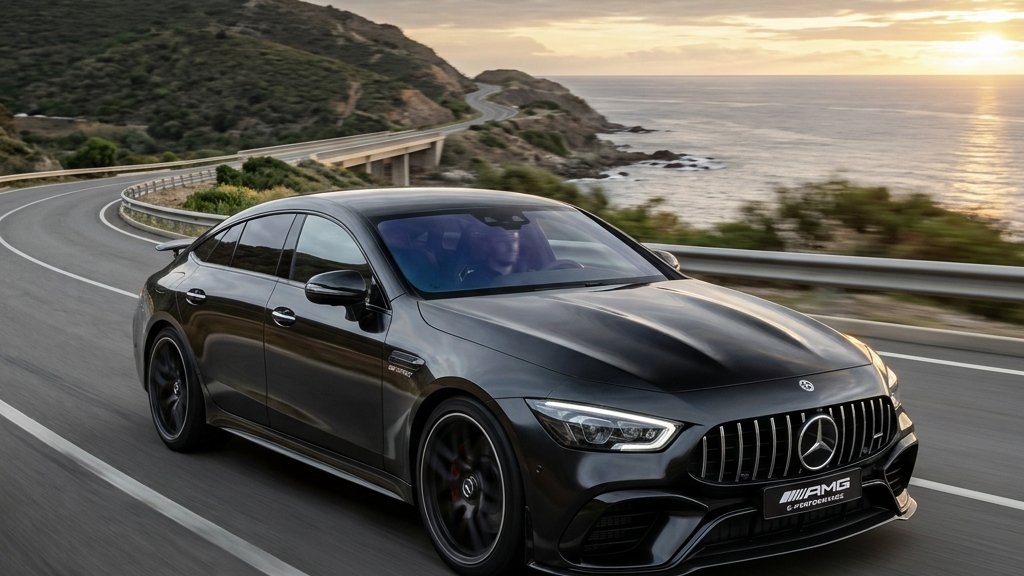
Why the Electric GT 4-Door Matters
AMG has already sold powerful electric models based on mainstream Mercedes-Benz platforms, including the Mercedes-AMG EQE and EQS derivatives. Those vehicles demonstrate impressive straight-line speed, but they were adapted from architectures designed to serve a wide variety of luxury-car priorities. AMG.EA takes a fundamentally different approach: its proportions, motor layout, battery cooling, software, suspension, and electrical system are being developed around high-performance requirements from the outset.
The production car is expected to succeed the role occupied by the AMG GT 4-Door Coupe rather than simply becoming an electric version of the current model. That means it should combine four usable doors and a practical luggage compartment with supercar-level responses. Its likely rivals include Porsche’s fastest Taycan variants and upcoming electric performance cars from Audi. For another perspective on this emerging segment, see the 2027 Audi RS6 Avant e-tron: All-Electric Super Wagon Performance Figures, Dual Motors, and Launch.
Confirmed AMG.EA Technology Versus Production Expectations
| Category | Confirmed or Demonstrated | Logical 2027 Production Expectation |
|---|---|---|
| Architecture | Dedicated AMG.EA electric platform | Low-slung four-door GT with performance-focused packaging |
| Motors | Compact axial-flux technology developed with YASA | Two- or three-motor all-wheel drive, depending on trim |
| Output | Concept AMG GT XX demonstrated more than 1,000 kW | Approximately 1,000 hp for a flagship version; unconfirmed |
| Battery | High-performance cylindrical-cell design with advanced cooling | Roughly 100-120 kWh usable capacity; estimated |
| Range | No final production rating announced | Approximately 300-400 miles WLTP, depending on specification |
| Charging | GT XX demonstrated an average charging rate above 850 kW under special conditions | Exceptionally rapid compatible-station charging, but likely below the demonstrator’s peak |
| Price | Not announced | Estimated from $150,000-$180,000, with flagship versions potentially above $200,000 |
Axial-Flux Motors: The Core AMG.EA Advantage
The most significant engineering feature is the axial-flux electric motor. Conventional radial-flux motors arrange magnetic flux outward from the rotor’s axis. An axial-flux unit directs it parallel to that axis, enabling a thin, disc-like package with very high torque and power density. Mercedes-Benz acquired specialist YASA in 2021, giving AMG access to expertise that could help reduce motor weight while freeing space for aerodynamics, suspension hardware, and battery systems.
The Concept AMG GT XX uses three axial-flux motors: one at the front and two at the rear. Mercedes-AMG says its concept powertrain exceeds 1,000 kW, equivalent to more than 1,340 hp. That figure is confirmed for the demonstrator, not for the road car. A production flagship producing around 1,000 hp is plausible because it would preserve a performance margin over existing AMG EVs without necessarily matching the concept’s laboratory-like headline output.
A three-motor layout could also permit precise rear-wheel torque distribution. Instead of relying entirely on brake intervention or a mechanical differential, software can vary each rear motor’s contribution almost instantly. The potential benefits include sharper turn-in, greater stability under power, controlled oversteer, and improved traction when exiting corners.
Acceleration and Top Speed
No official production acceleration time exists. With approximately 1,000 hp, all-wheel drive, and sophisticated launch control, a 0-60 mph time near 2.5 seconds is a reasonable estimate. Vehicle mass, tire capability, thermal limits, and the amount of torque allowed at low speeds will determine the final result. AMG may prioritize repeatability over chasing a single spectacular launch.
The Concept AMG GT XX has demonstrated a top speed above 360 km/h, or roughly 224 mph, during endurance testing. The showroom model may receive a lower electronic limit to protect tire life and preserve thermal headroom. A range of approximately 190-210 mph would still place it among the fastest electric four-door cars, but this remains speculative.
Battery Cooling, Charging, and Sustained Performance
Electric performance is not defined by peak horsepower alone. A vehicle can produce an enormous output for several seconds and then reduce power as its battery or motors heat up. AMG.EA is intended to address that weakness through direct battery-cell cooling, compact oil-cooled motors, and an electrical system designed to move substantial energy repeatedly.
Mercedes-AMG says the GT XX’s battery uses tall cylindrical cells with direct cooling around each cell. It has also demonstrated an average charging power above 850 kW over a charging session and approximately 400 kilometers of added range in about five minutes. Those achievements required specialized prototype infrastructure and must not be interpreted as guaranteed production-car capability at today’s public chargers.
The eventual road car is still likely to rank among the fastest-charging EVs available. Real-world results will depend on battery temperature, starting state of charge, charging-station voltage, charger output, weather, and software. Even if production charging peaks well below the concept’s figure, maintaining a broad and stable charging curve could make the car substantially easier to use on long journeys.
Expected Range and Everyday Efficiency
Mercedes-AMG has not published a certified range or final battery capacity. A sensible expectation is approximately 300-400 miles on the more optimistic WLTP cycle, with lower EPA figures in the United States. A performance version wearing wide tires and aggressive aerodynamic equipment would likely travel less far than an efficiency-oriented specification.
High-speed motorway driving will also reduce range significantly. Aerodynamic drag rises rapidly with speed, while cold weather, repeated acceleration, cabin heating, and track use impose additional energy demands. Buyers should therefore treat any future laboratory rating as a comparison tool, not a promise of identical real-world mileage.
AMG’s challenge differs dramatically from that faced by smaller urban EVs. The two interpretations of the 2027 Honda Super One EV: Ultra-Compact Urban Electric Runabout Specs and Global Launch and 2027 Honda Super One EV: Ultra-Compact Urban Electric Runabout Specs and Global Launch illustrate how vehicle size and mission can produce entirely different battery, range, and performance priorities.
Design, Cabin, and Practicality
Development prototypes and the GT XX concept indicate a low roofline, long wheelbase, cab-rearward visual stance, and carefully managed airflow. Active aerodynamic devices are likely because they can reconcile conflicting goals: low drag during cruising, battery cooling under sustained load, and greater stability at extreme speeds.
The production interior has not been revealed. It is reasonable to expect four adult-friendly seating positions, a large digital interface, AMG-specific drive displays, performance telemetry, route-based charging software, and high-grade materials. Physical controls for essential driving functions would be desirable in a car intended for fast road and track use, although Mercedes’ recent interiors suggest touch-sensitive interfaces will remain prominent.
Practicality should be better than in a two-door supercar, but the sloping roof may restrict rear headroom and cargo height. That compromise is central to the four-door GT formula: it aims to provide genuine daily usability without adopting the upright shape or high center of gravity of an SUV.
Chassis and Driving Character
AMG.EA will need to conceal considerable battery mass. Likely technologies include adaptive air suspension or advanced steel springs, rear-wheel steering, active roll control, powerful regenerative braking, and carbon-ceramic brakes on upper trims. These features are logical expectations based on AMG’s existing portfolio, not confirmed equipment for the 2027 car.
Regenerative calibration will be especially important. Drivers should expect selectable levels ranging from relaxed coasting to strong one-pedal deceleration. On a racetrack, AMG must blend regeneration and friction braking consistently so pedal response does not change as the battery fills or reaches its thermal limits.
Sound presents another challenge. AMG may use synthesized audio and physical vibration to communicate motor load and vehicle speed, but execution will matter more than volume. The goal should be useful feedback rather than an imitation of a V8. Other manufacturers face the same question as electric halo cars evolve, including the proposed 2027 Lexus LFA EV: All-Electric Flagship Supercar Concept, Solid-State Battery, and 0-60 Time.
Estimated Price and Launch Timing
Mercedes-AMG has not confirmed a final name, model-year designation, market launch date, or price. A 2027 model-year arrival is credible, but regional deliveries may begin at different times. Based on current AMG positioning and the cost of specialized motors, battery technology, and chassis hardware, an estimated starting price of $150,000-$180,000 is defensible. A highly equipped, three-motor flagship could exceed $200,000.
Those numbers are estimates, not manufacturer guidance. Currency movements, tariffs, battery costs, regional taxes, and whether AMG launches multiple power levels could materially alter the final price.
Final Assessment
The 2027 Mercedes-AMG GT 4-Door EV has the potential to become one of the defining electric performance cars of its generation. Its strongest argument is not a rumored 1,000-hp rating in isolation, but the integrated AMG.EA package: power-dense axial-flux motors, intensive battery cooling, exceptionally ambitious charging technology, active torque management, and four-door usability.
For now, the architecture and core technologies are real, while production output, range, acceleration, price, and equipment remain unconfirmed. If Mercedes-AMG can translate the Concept AMG GT XX’s extraordinary engineering into a durable and emotionally engaging road car, the result could establish a new benchmark for electric grand touring rather than merely replicate the performance of the combustion-powered AMG era.